Mission Objective
An auditory feedback system can help to motivate and support hemiplegic stroke patients to walk more symmetrically during stroke rehabilitation programs.
Overview
Rhythmic Auditory stimulation is well established in neurological rehabilitation programs by physiotherapists and neurologists programs. Rhythmic support in its raw form however can be overly simple to be enjoyable, which may distract from the benefits of auditory support. Researchers get around this by using known musical excerpts. Issues arise – firstly popular music has evolved in sympathy with bilateral symmetry and coordination, such as 2-4 and 4-4 time signatures. An issue arises when hemiplegic users walk with one side slower than the other, due to diminished motor control from neurological damage. Another issue is familiarity bias, when using familiar music other factors may influence the user that mean it is hard to test the true effect of the sound stimuli (such as where a strong emotional reaction is triggered by association).
Our system tracks Left and Right biomarkers independently, which then maps to the beat structure of the music, adapting to both sides of the body. The musical motifs for this project have all original pieces that attempt to produce engaging, yet not overly stimulating content – this is restricted to left and right hands on piano, and a simple beat. The sounds are also very simple, as this is a wearable system and so the software, sample instruments (using sound fonts), can run on a microprocessor.
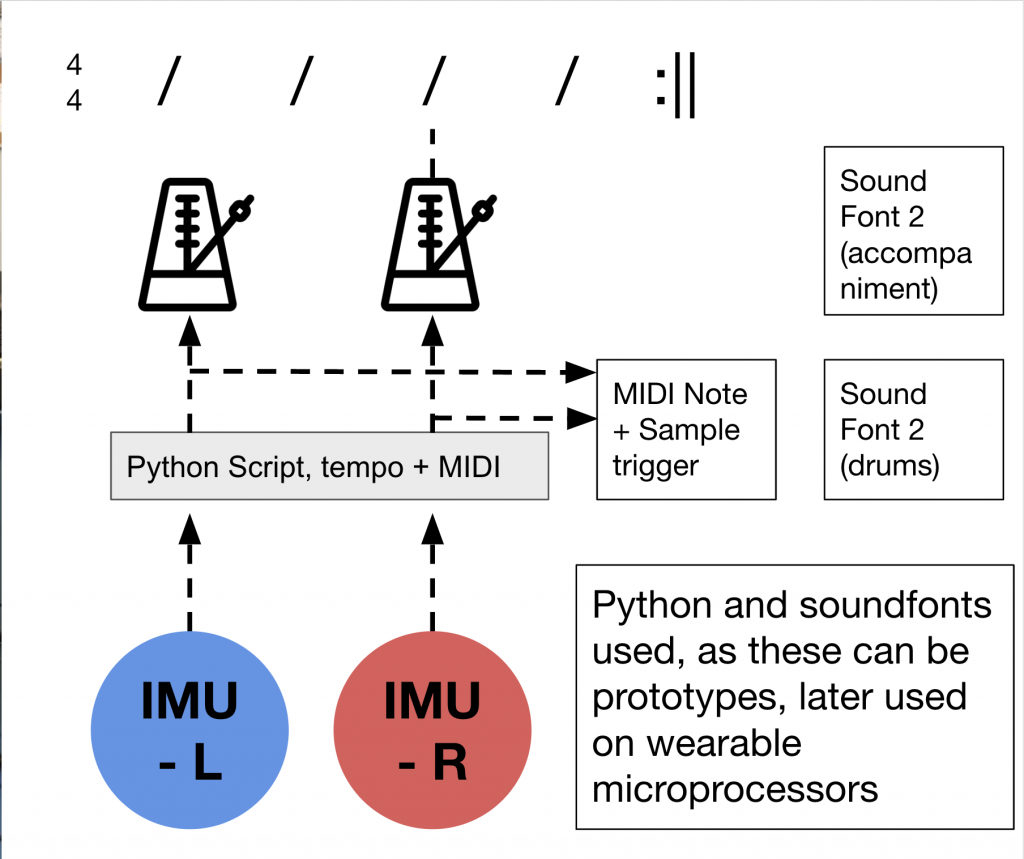
Figure: Signal flow of heel strike triggers and routing to MIDI, instrument and auditory feedback.
Images / Video
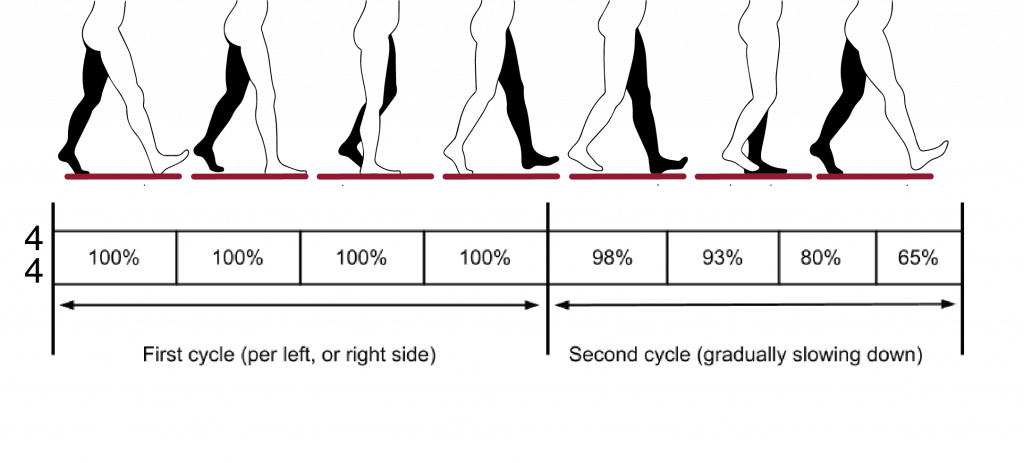
Treatment Motif
Below is an example of the sound output (treatment motif), as created with a basic sound font. A library of 40 original tracks were created, versions with or without percussion.
Collaborators
Andrzej Mitas
Daniel Lewoń
Patrycja Romaniszyn-Kania