Mission Objective
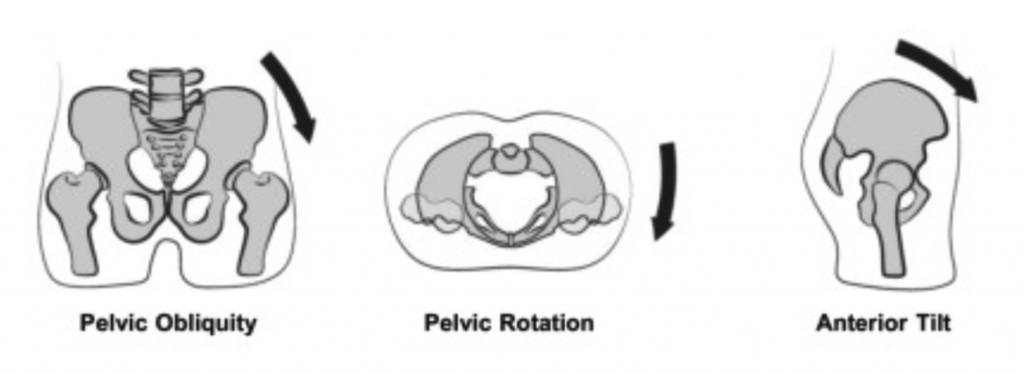
The pelvis area provides dynamic and complex movement information to describe a range of movements – including gait. Detail of movement in the participant’s pelvis is hard for them to perceive, auditory feedback could be an effective way to assess and experience detail within any or all of the planes of movement (obliquity, rotation and tilt), which could assist physiotherapists to guide and shape behavioural changes – in any movement where the pelvis is in operation.
Overview
It has been common to focus on in gait studies to use limb movement, and heel strikes, and less common to use pelvis movement. The pelvis is closely linked to the centre of mass (CoM) of human physical motion, and well suited to capture key movement information.
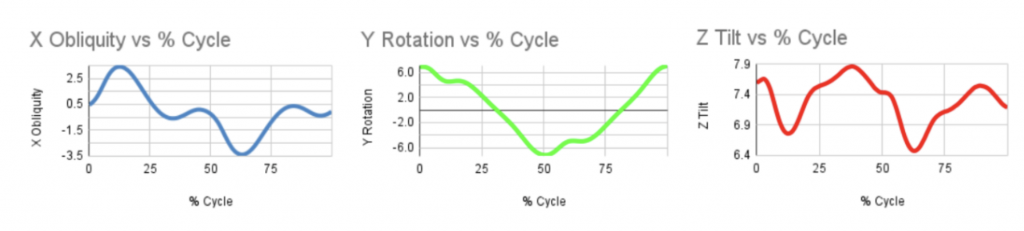
Three planes of measurement are possible with the use of biomarkers, and these can be charted as graphs. We were able to take obliquity, tilt and rotation with a range of participants. Commonly these cycles are fairly comparable between subjects even across genders.
We were able to try a broad range of transference potential, extracting 100 data points in a cycle across the three planes (, and converting these in Max MSP into MIDI information. A Max4Live instrument was created that meant there was efficient flexibility in assigning sound parameters to the three points. The benefit of this approach meant it was easy and fast to assess what data transferences worked intuitively.

Figure. Max4Live device – mapping one dimension of pelvis movement at a time (X, Y and Z).
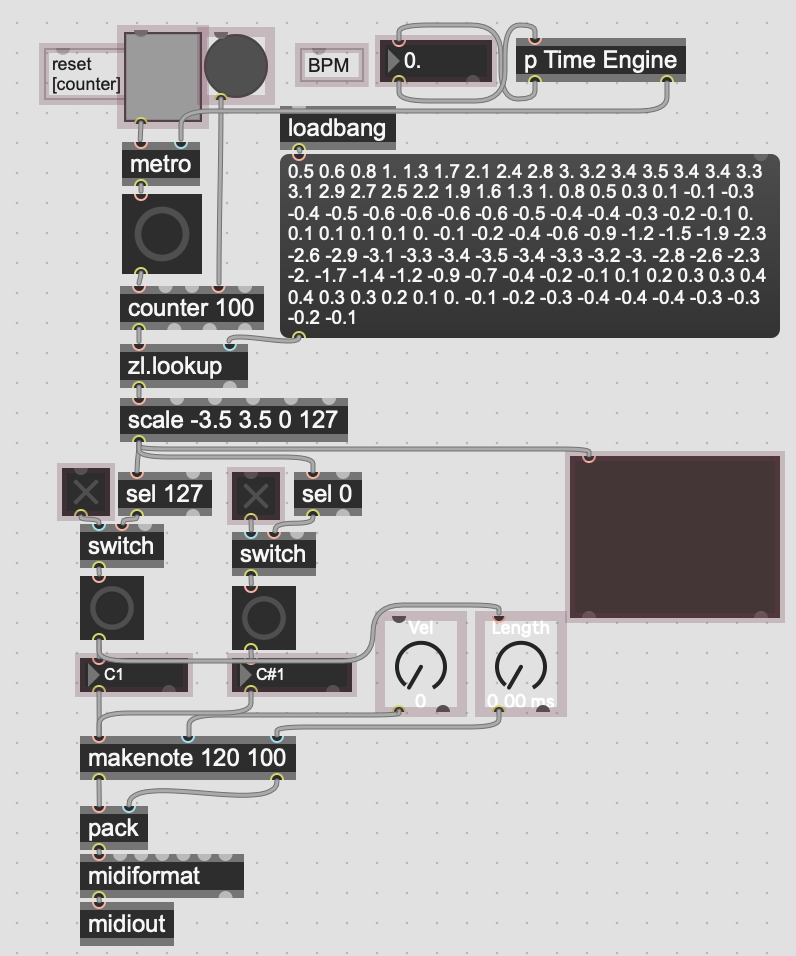
Figure. Max MSP patch, tracking the peaks and troughs of the graph, sending each out to a trigger, that can then be assigned to a sample (similar principle to a drum machine) – see examples 6 and 7 below for results.
Audio Results:
1. Complex – pitch and time quantisation
2. Obliquity To Pitch 2
3. Complex – Pads
4. Complex – Expressive responce
5. Bass Obliquity to LPF
6. 3 axis peak – note detection
7. 3 axis peak – Cuban
As the Sonification Handbook communicates, the audio needs an intuitive approach, which this practice based, trial and error exploration offers. The suite of Max for Live devices created enables some freedom of experimentation, with clarity of goal. One of the drawbacks with the concept is that in its natural form, the pelvis is (mostly) silent, and so when converted into other sonic values the results can be alien. Certain processes produce non-musical results which may be ineffective simply due to the participant’s willingness to accept the stimuli, if they were exposed to something too challenging this may engender a detrimental process to entrainment or participant engagement, especially in considering therapeutic functions.
Successful, aesthetic results can become known through trial and error, and with the development of the “instruments” created here. The data-to-pitch output is problematic, as this is a fairly fast melodic contour which is unsettling, disorienting and to a great extent unpleasant (like an amateur theremin player). This can be resolved to some extent by note quantisation to scales (e.g., using the Ableton Scale MIDI effect), however this then abstracts the data too much to be relatable to the source. Despite this abstraction it would be interesting to observe if the aesthetic results achieved, through processing the signal through pitch and time quantisation, might entrain a willingness to synchronise with symmetrical movement. In the samples represented in this paper the Z axis – ‘Tilt’ features less prevalently, largely due to its subtler effect. There is great potential to integrate all axes simultaneously with the use of drum patterns (i.e. one drum per plane).
Realistically the effectiveness of these materials can only be known in application, which is the next phase of study, and so this only offers a qualitative entry point into materials creation for future application; measuring participant’s physiological and psychological responses. It is a useful procedure however and evaluation at this stage is essential to calibrate the sonification literature with the materials. As an addition for future consideration there could be more preoccupation with pitch range, making better use of sensitive areas of hearing for sonification detail, so as to scale the data, and package this within the ranges of 800 Hz – 3 kHz. Typically more detail is experienced in this band width, and might offer a higher resolution in communicating details of movement.sonification
Turner, B., Tuszy, A., Gawłowski, A., et al (2023) “Parameter Mapping Sonification (PM Son) of the Pelvis in Gait, For the Purpose of Developing Symmetrical Gait Behaviours.” In HealthTech Innovation Conference 2023. 1 November 2023. Springer.
Collaborators
Andrzej Mitas
Piotr Szaflik
Hanna Zadon
Aleksandra Tuszy